The bathrooms in billionaire estates aren’t just functional spaces, they’re private sanctuaries engineered with the same attention to detail as museum galleries. These rooms combine materials most homeowners will never see in person, technology that anticipates needs before they’re felt, and craftsmanship measured in months, not days. While few of us will install a $200,000 marble tub or commission hand-carved fixtures, understanding what makes these spaces exceptional reveals design principles and features that can be adapted at nearly any budget. This guide breaks down the specific materials, technologies, and design strategies that define billionaire bathrooms in 2026, and shows how to translate those ideas into your own renovation.
Table of Contents
ToggleKey Takeaways
- A billionaire luxury mansion bathroom combines custom materials, smart technology, and meticulous craftsmanship in spaces typically exceeding 300–600 square feet with dedicated zones for soaking, steam showers, and lounge areas.
- Opulent materials like book-matched marble, backlit onyx, and custom metalwork create million-dollar bathrooms, but one statement element—such as a marble accent wall—can bring luxury bathroom design to average homes for $3,000–$8,000.
- Smart technology systems from brands like Lutron, Kohler DTV+, and Toto Neorest automate temperature, lighting, and steam functions, though benefits focus on daily comfort rather than novelty features.
- Proper waterproofing with RedGard or Kerdi membranes, dedicated electrical circuits for 240V systems, and radiant floor heating represent invisible infrastructure investments that enable luxury features and prevent costly failures.
- Prioritize quality fixtures in premium finishes paired with well-executed tile work and lighting layers over attempting to replicate full billionaire-level builds, and always hire specialists for complex plumbing, electrical, and stone installation work.
What Defines a Billionaire-Level Luxury Bathroom?
Scale sets the first baseline. These aren’t 5×8 powder rooms. Billionaire bathrooms routinely exceed 300–600 square feet, larger than most studio apartments. That space accommodates separate zones: a soaking area, steam shower enclosure, dressing room, and sometimes a fireplace or sitting area with views.
Customization defines every surface. Nothing comes from a showroom floor without modification. Fixtures are specified to exact finish requirements, stone is book-matched across multiple slabs for continuous veining, and even hardware is often cast in limited runs. The goal isn’t brand recognition, it’s uniqueness that can’t be replicated.
Craftsmanship shows in the details most people won’t notice. Grout lines align perfectly across floors and walls. Drain covers are milled from the same stone as the shower pan. Light switches sit flush with wall planes. These spaces are built to tolerances closer to fine furniture than typical residential construction, often requiring specialized tradespeople and installation timelines of 8–12 weeks for a single bathroom.
Privacy and acoustics get engineered, not assumed. Walls often include additional mass-loaded vinyl or double-stud construction to eliminate sound transfer. Windows use electrochromic glass that switches from clear to opaque on command. The expectation is total sensory control.
Opulent Materials That Create Million-Dollar Bathrooms
Material selection in these bathrooms goes beyond durability or aesthetics, it’s about rarity and provenance. Countertops might feature Patagonia granite or Sodalite Blue, stones with limited global supply and price tags exceeding $800 per square foot before fabrication. These aren’t materials you’ll find at local stone yards.
Onyx appears backlit in shower walls and vanity fronts, chosen for translucency and dramatic veining. Installation requires structural backing capable of supporting 18–25 pounds per square foot for 3cm slabs, plus low-voltage LED systems integrated behind the stone. Electrical work must meet NEC Article 410 for wet location lighting, this isn’t a DIY-friendly retrofit.
Metalwork often involves unlacquered brass, bronze, or even rose gold PVD finishes that require specialized applicators. Expect patina development on raw metals, which is intentional. Polished nickel and chrome are considered too common. Custom fittings from European manufacturers like Dornbracht or Gessi can run $15,000–$40,000 for a complete bath set including tub filler, shower system, and fixtures.
Flooring might incorporate radiant heating beneath reclaimed French limestone or wide-plank teak with marine-grade finishes. Wood in bathrooms requires meticulous waterproofing: full Schluter or similar membrane systems, sealed subfloors, and controlled ventilation to maintain 30–50% relative humidity year-round.
Rare Stone and Custom Marble Installations
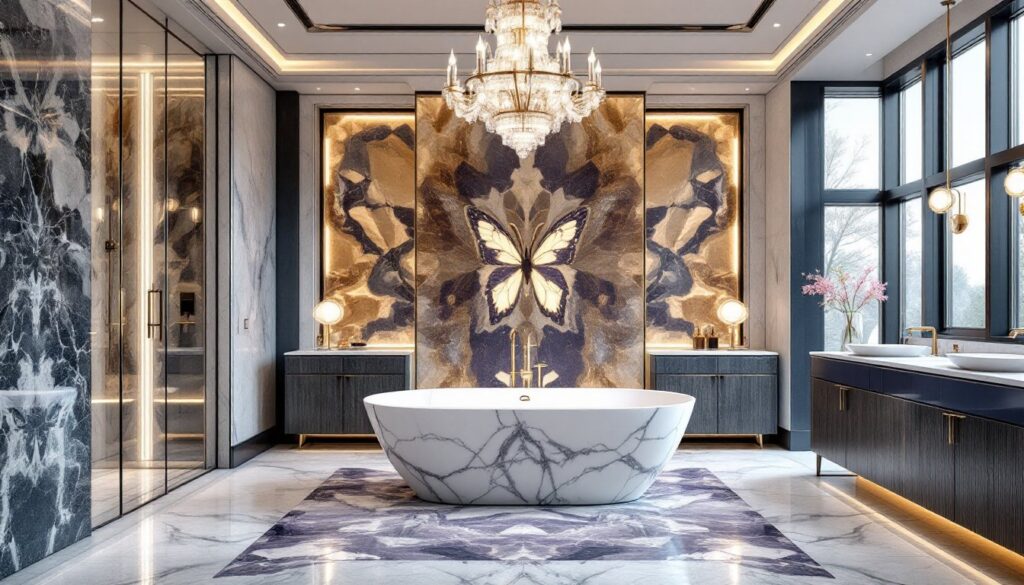
Book-matched marble creates mirror-image patterns across walls, requiring slabs cut from the same block and sequenced during installation. Calacatta Viola, Nero Marquina, and Arabescato Corchia appear frequently, with material costs alone reaching $30,000–$60,000 for a single bathroom.
Installation demands precision. Slabs are typically 2cm or 3cm thick, mounted with mechanical clips and epoxy to cement board over moisture barriers. Vertical installations require metal framework capable of supporting the dead load, marble weighs roughly 14 pounds per square foot at 2cm thickness. Most jurisdictions don’t require permits for non-structural finish work, but verifying backing attachment to studs matters for safety.
Sealing is non-negotiable. Even honed marble needs impregnating sealers reapplied every 6–12 months in high-moisture environments. Etching from soap and hard water is inevitable without proper maintenance, something professional housekeeping staffs handle in these homes, but average homeowners need to budget time and products for.
Smart Technology and Automated Luxury Features
Control systems integrate every function. Lutron or Crestron whole-home automation extends to bathrooms with scene programming: “Morning” might gradually raise blackout shades, warm floors to 78°F, start the steam shower, and adjust lighting to 3000K color temperature. These systems require low-voltage wiring during construction and professional programming, not something added during a quick remodel.
Digital shower systems like Kohler’s DTV+ or Steamist’s Total Sense allow users to program water temperature (±1°F accuracy), steam duration, chromatherapy lighting sequences, and aromatherapy dispensing from wall-mounted touchscreens or smartphone apps. Installation requires dedicated 240V circuits for steam generators (typically 7.5–15kW depending on enclosure volume), GFCI protection, and water supply lines with thermostatic mixing valves to prevent scalding.
Toilets incorporate bidet functions, heated seats, automatic lids, deodorizers, and even health monitoring sensors that analyze waste. Toto’s Neorest NX2 and Kohler’s Veil Lighted models represent the category, with price points around $10,000–$18,000. These require 120V GFCI-protected outlets within 6 feet per NEC standards, something to verify before purchasing.
Mirrors go beyond defog functions. Integrated displays show weather, news, or calendar appointments. Some incorporate circadian lighting that shifts color temperature throughout the day. Electric mirror installations need backing boxes for power and, if smart-enabled, ethernet or strong Wi-Fi signal. Fogless operation typically uses resistive heating drawing 50–150 watts, wired to bathroom lighting circuits or controlled independently.
Spa-Inspired Elements Billionaires Install in Their Bathrooms
Steam showers built to commercial spa standards use fully sealed enclosures with sloped ceilings to prevent drip-back. Enclosures must be waterproofed with sheet membranes like Kerdi or RedGard, and all seams require proper overlap and sealing. Steam generators are sized by cubic footage, calculate ceiling height × width × length, then consult manufacturer charts accounting for exterior walls, glass, and ceiling material.
Saunas, both traditional and infrared, appear in larger bathroom suites. Traditional Finnish saunas require dedicated 240V circuits (often 30–60 amps depending on heater size), proper venting, and fire-rated construction if built against combustible framing. Infrared units draw less power (120V, 15–20 amps) but still need GFCI protection and clearances from water sources per manufacturer specs.
Chromatherapy and aromatherapy systems integrate LED lighting into steam heads and showers. While the wellness claims are debated, the execution involves low-voltage RGB LED strips (typically 12V or 24V), waterproof drivers, and essential oil dispensers plumbed into steam lines. Quality installations from companies like Architectural Digest frequently features in high-end bathroom projects require isolating transformers and proper wire gauge to prevent voltage drop over distance.
Freestanding soaking tubs made from single blocks of marble or cast composite materials become focal points. Marble tubs weigh 800–2,000+ pounds empty: floor joists may require sistering or supplemental beams underneath. Stone tubs hold heat poorly compared to cast iron or acrylic but deliver unmatched visual impact. Filler faucets need flow rates of 8–15 GPM to fill oversized tubs in reasonable time, most residential water heaters deliver 5–7 GPM, meaning tankless or dedicated recirculation systems become necessary.
Statement Fixtures and Custom-Made Centerpieces
Custom vanities aren’t built from stock cabinets. These are furniture-grade pieces in exotic woods, Macassar ebony, figured walnut, or bleached oak, with full-extension soft-close drawer slides rated for 100+ pounds, undermount sinks carved from single stone blocks, and integrated lighting.
Construction involves dovetail or mortise-and-tenon joinery, multiple finish coats (8–12 for hand-rubbed oils), and hardware machined specifically for each piece. A double-sink vanity built to these standards runs $25,000–$60,000 before countertops and plumbing. Installation requires two or more people and precise leveling, these pieces weigh 300–500 pounds.
Chandeliers and sculptural lighting bring jewelry-scale detail to bathrooms. Wet-rated fixtures are mandatory within 8 feet horizontally and 3 feet vertically of tubs and showers per NEC 410.10. Materials like crystal, hand-blown glass, or bronze require confirming junction box support, standard boxes support 50 pounds, but many statement fixtures exceed this and need independent structural blocking.
Plumbing fixtures become art. Wall-mounted tub fillers in hand-forged bronze, rainfall showerheads measuring 20–30 inches across, and hand-hammered copper sinks all require rough-in coordination during framing. Wall-mount faucets look clean but demand precise backing placement, typically 2×6 or 2×8 blocking between studs to support valve bodies and provide solid mounting. Tile or stone goes up after plumbing, so test fittings should happen before final finish work.
How to Bring Billionaire Bathroom Design to Your Home
Start with one statement element rather than trying to recreate entire billionaire-level builds. A single slab of book-matched marble as an accent wall behind a freestanding tub delivers dramatic impact for $3,000–$8,000 installed, substantial, but achievable compared to full-room installations. This works in bathrooms as small as 60–80 square feet if planned carefully.
Prioritize quality over quantity in materials. Using premium fixtures in polished nickel (Kohler Artifacts or Delta Trinsic lines, $800–$2,000 for tub and shower sets) paired with well-executed standard porcelain tile reads far better than cheap interpretations of luxury materials. Unlacquered brass or oil-rubbed bronze ages beautifully and brings warmth without the cost of exotic finishes.
Invest in invisible infrastructure. Running a dedicated 20-amp circuit for heated floors or adding blocking for future fixture upgrades costs little during renovation but enables significant upgrades later. Homeowners exploring luxury houses for sale often find properties with robust electrical and plumbing infrastructure command premium pricing.
Radiant floor heating transforms comfort with material costs around $10–$15 per square foot** for electric mat systems (Schluter DITRA-HEAT or SunTouch), plus installation. Systems require GFCI-protected circuits and programmable thermostats. Installation happens during tile work, membranes go down over cement board, mats embed in thinset, then tile adheres on top.
Focus on lighting layers. Combining recessed LED cans (IC-rated for insulation contact, about $25–$40 each), sconce lighting at mirrors (mounted 60–66 inches to center for typical users), and accent lighting creates depth. Dimmer controls add flexibility, electronic low-voltage (ELV) dimmers for LED fixtures prevent buzzing and flickering. Budget $800–$1,500 for quality lighting in a 100-square-foot bathroom, installed.
Consider tech where it solves real problems. A $400 Toto Washlet bidet seat on a standard toilet delivers meaningful comfort improvement. Smart mirrors with defoggers ($600–$1,200) eliminate frustration every morning. But avoid novelty features like shower speakers that rarely get used, focus on daily quality-of-life gains.
Tile layout matters as much as tile choice. Running large-format tiles (12×24-inch or bigger) in a brick or stacked pattern with minimal grout lines mimics high-end installations. Use leveling systems (T-Lock or similar) to prevent lippage on large tiles, a $40 investment that dramatically improves finished appearance. Resources like Remodelista provide detailed installation techniques for achieving professional results.
Don’t skip waterproofing systems. RedGard or Kerdi membranes add $200–$400 in material for typical bathrooms but prevent catastrophic failures. Apply over cement board (HardieBacker or similar), lapping seams 2 inches minimum, sealing all corners and penetrations. This isn’t visible in finished work, but it’s the difference between a bathroom that lasts 20+ years and one that fails in five.
Permits apply to electrical, plumbing, and structural work in most jurisdictions, check local requirements before starting. Cosmetic updates like tile, paint, and fixture swaps typically don’t require permits, but moving plumbing lines or adding circuits does. Budget 2–3 weeks for permit approval in most areas. Features showcased on Home Bunch often represent professional installations meeting all code requirements.
Hire specialists for complex work. Tile setters who work with large-format or natural stone charge $8–$15 per square foot labor, but the results justify costs on featured elements. Licensed electricians prevent code violations and safety issues on 240V circuits. Reserve DIY efforts for demolition, painting, and fixture installation where skills match the task.